The Top 5 Tips for Extension Filers
llopezcpas
on
September 9, 2026
Extension filers don’t have to wait until Oct. 15, 2026, to file their federal tax return. Taxpayers are encouraged not to wait and to take steps to help them prepare an accurate return. Let’s go over a few tips to make completing the return quick and easy.
Gather and review tax documents
Complete and accurate records can reduce errors and delays. Individual taxpayers can access their IRS Individual Online Account to view account information and transcripts, make payments, and manage communication preferences.
Use IRS Free File, if eligible
Taxpayers can see if they are eligible to file their return for free through IRS Free File. The program is available to taxpayers who had an adjusted gross income of $89,000 or less in 2025. IRS Free File is guided tax preparation and can help taxpayers determine their eligibility for many valuable tax credits.
IRS Free File Fillable Forms is available to taxpayers who are comfortable preparing and filing their own returns. Regardless of income level, taxpayers can still electronically file their returns at no cost.
Additionally, many Volunteer Income Tax Assistance and Tax Counseling for the Elderly still offer free basic tax return preparation to qualified individuals, including:
- People who generally qualify for the Earned Income Tax Credit
- Persons with disabilities
- Limited English-speaking taxpayers
Know what to look for, if choosing a tax pro
Some may choose to use a tax professional to complete and file their return. A tip earlier this year, provides important tips when choosing a tax pro.
Don’t wait until the last minute
The extension to file is not an extension to pay. The deadline for extension filers is Oct. 15, 2026. Taxpayers should file electronically and choose direct deposit for their tax refund – it’s the fastest and safest way to receive their money.
Taxpayers in disaster areas may have more time to file. Information on the most recent tax relief for disaster situations is available on the IRS website.
Payment options
Those who owe taxes and can’t pay their balance in full should pay as much as they can to reduce interest and penalties for late payment. The IRS has options for people who can’t pay their taxes, including applying for a payment plan on IRS.gov. Taxpayers can view payment options or check their account balance online.
2026 CalCPA Firm Awards Nominee
llopezcpas
on
August 13, 2026
“Hot off the Press”
Release, August 13, 2026
Enhanced Deduction for Seniors
llopezcpas
on
August 5, 2026
There are some changes for the 2026 tax filing season that people who are 65 years of age and older should be aware of. The most recent being the enhanced deduction for seniors, which is a provision of the One, Big, Beautiful Bill.
The IRS is sharing what’s new, as well as some reminders specifically for seniors.
Enhanced deduction for seniors
A new deduction that is in addition to the current additional standard deduction for seniors under existing law.
- For tax years 2025-2028, taxpayers who are age 65 or older may be eligible to claim an additional $6,000 deduction per person ($12,000 if married filing jointly and both spouses are eligible)
- To be eligible, the person must be 65 on or before the last day of the tax year
- It is available to eligible taxpayers who claim the standard deduction or itemize
- The deduction phases out for taxpayers with modified adjusted gross income over $75,000 ($150,000 for joint filers)
Earned Income Tax Credit
- EITC helps low to moderate-income workers and families get a tax break
- The maximum income amount for claiming the credit for the 2025 tax year is $68,675. The amount of the credit may vary based on income, family size and filing status.
Equine Industry – Core Services Offered
llopezcpas
on
August 5, 2026
Monthly Recurring Revenue
- Bookkeeping packages
- Payroll processing
- Sales tax filing
- Financial reporting
- Advisory retainers
Seasonal Revenue
- Tax preparation
- Tax planning
- Entity structuring
- Audit support
- IRS/state notices
Premium Advisory Services
- Business growth consulting
- Profitability analysis
- Succession planning
- Inventory controls for tack/feed stores
- Cash flow forecasting
- QuickBooks setup and cleanup
3 Common
Tax Mistakes Farriers Make
llopezcpas
on
August 5, 2026
A farrier’s mobile workshop creates accounting and tax issues that can easily be overlooked—from specialized equipment and vehicle expenses to California depreciation differences and sales-tax obligations.
Our experienced CPA firm understands the accounting and tax issues affecting the equine industry and professional farriers. We can help you identify lawful tax-planning opportunities, meet your compliance obligations, and make informed financial decisions. Tax treatment and outcomes depend on each client’s individual circumstances.
Here are three common issues professional farriers should consider:
1. Overlooking the De Minimis Safe Harbor
Eligible businesses may elect to deduct qualifying tools and equipment costing up to $2,500 per invoice or item rather than capitalizing and depreciating them. Specific recordkeeping, accounting-policy, and tax-return requirements apply.
2. Overlooking Federal and Multistate Depreciation Differences
State tax rules do not always follow federal depreciation provisions. California and some other states limit or disallow certain federal deductions, including bonus depreciation, while others conform more closely to federal law. Farriers operating or filing returns in multiple states may need separate depreciation schedules and state-specific adjustments to avoid reporting errors or unexpected tax liabilities.
3. Misclassifying Sales and Service Revenue
Charges for trimming and other services may be treated differently from sales of pads, treatments, or other tangible products. The correct sales-tax treatment—and applicable district tax—depends on what is sold, how it is invoiced, and where the transaction occurs.
Don’t let one-size-fits-all tax preparation overlook the details of your farrier business. Email us at info@llopezcpa.com or call 650-361-1235, extension 3, to discuss whether our firm would be a great fit for you!
Tax Scams Related to the One, Big, Beautiful Bill (Part 1)
llopezcpas
on
June 19, 2026
The One, Big, Beautiful Bill introduces new and expanded tax benefits. While these changes may help taxpayers, they can also create confusion, especially during the first filing season when they apply. Scammers often exploit uncertainty surrounding new laws.
Taxpayers should watch for the following OBBB-related scams and take steps to protect their personal and financial information.
Ghost preparers exploiting new credits
Unlicensed or unethical tax preparers may promise large refunds by aggressively or falsely claiming new OBBB credits. These preparers may:
- Exaggerate eligibility for deductions
- Claim credits that taxpayers do not qualify for
- Disappear after filing, leaving the taxpayer responsible for penalties, interest, or audits
Red Flag: The preparer refuses to sign the return or provide a valid Preparer Tax Identification Number.
Tips and overtime deduction scams
Dishonest tax preparers advertise “expert” help to claim the tip and overtime deductions, charging excessive fees and inflating amounts on returns. Common tactics include:
- Promising unusually large refunds tied to tips or overtime
- Guaranteeing eligibility
- Inflating or inventing deduction amounts without proper documentation
OBBB provisions require accurate reporting of qualified tips and overtime. Because early information forms may not clearly reflect these amounts, scammers can exploit the complexity to justify improper claims.
Red Flag: The preparer will not explain how amounts were calculated, or claim documentation is unnecessary.
Deduction for seniors “enrollment” scam
The new OBBB deduction for seniors does not require enrollment, advance registration, or third-party sign-up. Eligible seniors can claim the deduction when filing their tax return with the IRS.
Scammers may target seniors through unsolicited calls, texts, emails, or mailers that claim they must:
- Enroll immediately to receive the deduction
- Verify personal information to qualify
- Pay a processing or application fee
- Click a link and provide their Social Security number or bank information
Red Flag: The preparer claims you must enroll, register, or pay a fee to receive the deduction. The IRS does not require “enrollment” or payment to claim a deduction.
Need To File An Amended Return?
llopezcpas
on
June 10, 2026
IRS Tax Tip 2026-35, April 28, 2026
Taxpayers who discover an error after filing a federal tax return may need to file an amended return. There are some instances where an amended return isn’t required such as when the IRS corrects errors during processing or requests missing forms or schedules separately.
Reasons to file an amended return
If there are changes to key items on the original return, including:
- Filing status
- Income
- Deductions
- Credits
- Dependents
- Tax liability
Taxpayers can use the Should I file an amended return? tool within the IRS Interactive Tax Assistant to help decide if they should file an amended return to correct an error or make other changes if they already filed.
Time limits
To claim a refund, an amended return must generally be filed within:
- Three years from the date the original return was filed, or
- Two years from the date the tax was paid, whichever is later
If the original return was filed early, the three-year period begins from the April tax deadline. Special rules apply when there are net operating losses, foreign tax credits, bad debts or other issues. Additionally, taxpayers in disaster relief situations, combat zone service, have bad debts, foreign tax credits, or loss or credit carrybacks, may have more time to file an amended return.
How to file an amended return
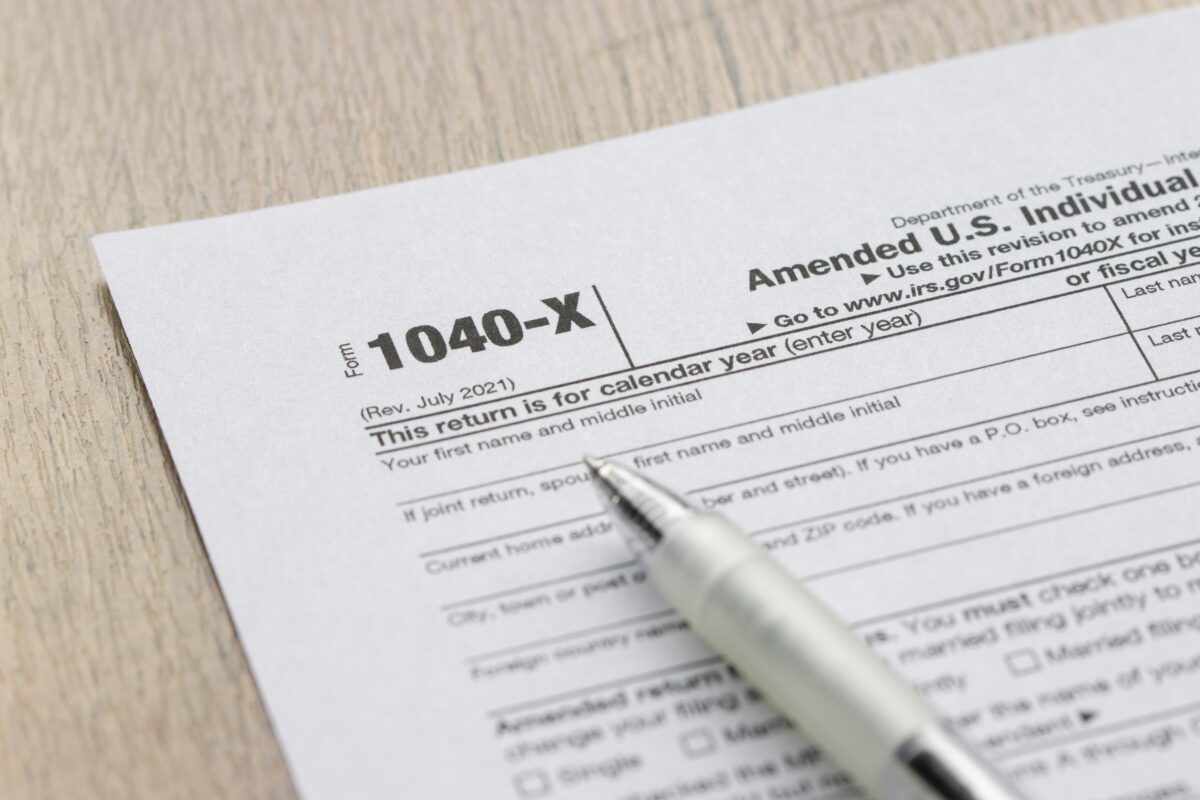
Taxpayers must file Form 1040-X, Amended U.S. Individual Income Tax Return. When filing, they should:
- Submit a corrected Form 1040, 1040-SR, or 1040-NR for the applicable tax year
- Attach any supporting documents and updated forms or schedules
Refunds and payments
For tax years 2021 and later, taxpayers may request direct deposit of refunds when filing electronically. If additional tax is owed, payment should be submitted with the amended return. The amended return replaces the original return, and the IRS will calculate any applicable penalties or interest if filed after the due date.
Status of amended return
Taxpayers can check the status of an amended return approximately three weeks after it’s submitted. It generally takes 8 to 12 weeks for it to be processed. However, in some cases, processing could take up to 16 weeks.
State tax considerations
Changes to a federal return may affect a taxpayer’s state tax liability. Taxpayers should contact their state tax agency for guidance and should not attach state returns to the federal amended return.
For More Information Please Visit www.irs.gov
L. Lopez CPA & Associates Offers Services To The Equine Industry
llopezcpas
on
May 26, 2026
The equine industry is unlike any other business — and your accounting firm should understand that. At L. Lopez CPA & Associates, we combine professional tax and accounting expertise with real-world equestrian experience. From horse trainers and boarding facilities to breeding operations, tack shops, feed stores, equine service providers, and veterinarians, we deliver specialized bookkeeping, payroll, tax preparation, and sales tax services tailored specifically to the horse industry. We understand the financial demands, seasonal cash flow, competition schedules, staffing challenges, and operational complexities unique to equine businesses nationwide
With a background in horse showing, jumper competitions, and equestrian retail operations as owners of the ‘Tie Down Tack Shop for 25 years in Los Altos, California, our team brings industry insight that goes beyond the numbers. We help equine professionals stay compliant, improve profitability, streamline operations, and gain financial clarity so they can focus on running successful programs and caring for their horses and clients.
Whether you manage a large training barn or a growing horse-related business, we provide trusted financial guidance designed to support long-term growth and success in the equestrian world.
Call us today to get started by calling 650-361-1235
Protecting Yourself From IRS Scammers
llopezcpas
on
April 20, 2026
Know how and when the IRS contacts you so you can protect yourself from impersonators.
Ways The IRS contacts you
The IRS typically contacts you the first time by mail delivered by the U.S. Postal Service.
To verify it’s the IRS, search IRS notices and letters. Some letters are sent from private collection agencies.
Other ways the IRS may contact you:
- Email – They email only with your permission, with a few exceptions like criminal investigations.
- Text message – They text you only with your permission.
- Phone – The IRS or private collection agencies may call you to address account matters. In some cases, IRS uses automated messages that direct you to IRS.gov to securely manage your account, make payments or resolve an issue. The messages don’t share specific details.
- Fax – They might send a fax to verify or request employment information.
- In-person visit – These are rare. Find out how and when IRS employees visit you or your business. The IRS generally sends a letter before we visit.
The IRS doesn’t:
- Direct message or take payment on social media. Follow our social media accounts
- Accept gift cards or prepaid debit cards as payment
- Call with automated messages that threaten or direct to websites that aren’t IRS.gov
- Threaten to call law enforcement or immigration officials
- Take your citizenship status, driver’s license or business license
- Mail tax debt resolution advertisements
If the IRS visits you
Unannounced visits are rare. Only 4 types of IRS employees may visit your home or business. Each contacts you in specific ways and carries official identification (ID).
Revenue agents – examinations (audits)
Revenue officers – collections
Special agents – criminal investigations
Fuel inspectors
Identification the IRS carries
Revenue officers, revenue agents and fuel inspectors carry an IRS-issued credential (pocket commission) and HSPD-12 card. Both have the employee’s serial number and photo. You can ask to see both.
- You may ask to see an additional ID from revenue agents and fuel inspectors.
- Fuel inspectors also wear uniforms and drive government vehicles.
Criminal Investigation special agents present law enforcement credentials when they investigate.
If you feel unsafe, call 911
If the person doesn’t show you these IDs or you aren’t sure about them, call the number on the card provided by the revenue officer or agent. For more information go to www.IRS.gov